


Here’s a structured approach to building up your FEA knowledge in structural dynamics, divided into three phases.

1. Build the Fundamentals of Structural Dynamics
Before diving into FEA tools, it’s essential to grasp the physical and mathematical principles behind dynamic behavior.
✅ Key Concepts to Master:
Free vibration (undamped and damped systems)
Forced vibration (harmonic, transient, shock)
Modal analysis (natural frequencies and mode shapes)
Frequency response and resonance
Time integration methods (implicit vs. explicit solvers)
Damping models (structural, viscous, Rayleigh)
2. Transition to Dynamic FEA Concepts
Once fundamentals are in place, start translating them into FEA terms. In commercial solvers, dynamics analyses are often segmented into:
Modal Analysis
Harmonic (Frequency Response) Analysis
Transient (Time Domain) Analysis
Random Vibration / PSD Analysis
Response Spectrum Analysis (for seismic or launch scenarios)
Explicit Dynamics (for crash, impact, shock)
✅ Key FEA Skills to Learn:
Setting up and interpreting a modal analysis
Applying frequency-dependent loads and boundary conditions
Choosing correct time integration methods
Managing numerical damping and time step stability
Extracting and interpreting modal participation factors, FRFs, or time histories
3. Hands-On Simulation Practice
Once you’re grounded in theory and familiar with FEA capabilities, the key is application through real or benchmark problems.
🧪 Exercises to Try:
Modal analysis of a cantilever beam and a shell structure (verify with hand calcs)
Harmonic excitation on a bolted bracket
Transient shock load on a frame
PSD input on avionics box with base excitation
Impact analysis using explicit solvers (if available)
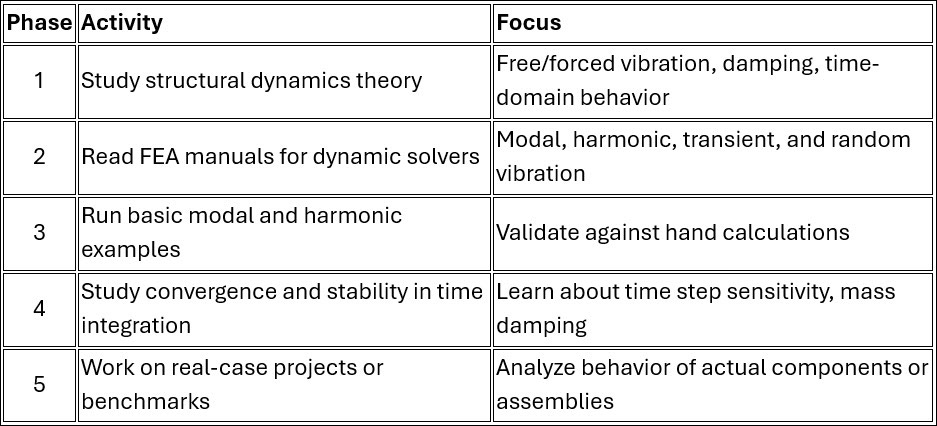
4. Progressive Learning Roadmap
Final Advice
Treat structural dynamics as both a theoretical discipline and a simulation technique. Mastery comes from bridging both.
I Need You
In 2027, FEA Academy will release a complete course dedicated to Dynamic Analysis by FEA.
The curriculum is already extensive and the lecture structure is finalized, but before going further, I want to make sure nothing important has been overlooked.
Which topics would you like this course to cover? Share them in the comments. Your input will help shape the final content.