


Not every engineering task needs an agent. Some need a rule, some need judgement, and a few need a whole team. Here is a practical way to tell them apart.
“Agentic AI” is everywhere this year, and injection molding is no exception. The term is used for everything from a script with a chatbot on top to fully autonomous design loops. For engineers who have to decide what is worth trying, that vagueness is a problem.
A more useful way to look at it is as a progression. Each level adds autonomy, and each level also adds new questions about control and trust. Synera’s upcoming webinar, Behind the Scenes of Injection Molding, follows exactly this progression with three workflows on real parts, so I will use its examples to make each level concrete.
Level 1: Rule-based automation
The first level is not AI at all, and that is the point. A rule-based workflow chains known steps in a fixed order: import the geometry, apply the process settings, run the simulation, check the results against thresholds, write the report. Every decision is an explicit rule that an engineer wrote down.
This is where most of the value still sits for repetitive tasks. The behaviour is predictable, the results are traceable, and the workflow does the same thing every time. Its limit is also clear: it only handles what the rules anticipated. Unstructured input, such as a customer document written in natural language, falls outside it.
In the webinar: a designer iterates the ribbing pattern on a washing machine plate to reach low warpage, without waiting days for results.
Level 2: An agent in the workflow
The second level keeps the deterministic workflow but places an agent at one step where interpretation is needed. The agent does not run the process. It takes a task that used to require a person reading and summarizing, and turns it into structured input the rest of the workflow can use.
Requirements documents are a natural candidate. They are long, they mix tables, prose and references to standards, and the relevant constraints are spread across many pages. An agent can read the document, extract what matters for the part, and pass it on. The engineer reviews the output rather than producing it.
The key design choice at this level is the boundary. The agent has one clear job, a defined input and a defined output, so its work can be checked before anything downstream depends on it.
In the webinar: agents read a 30-page automotive requirements PDF, extract the engineering requirements and feed them straight into the workflow.
Level 3: A team of agents
The third level replaces the single agent with several, each responsible for one part of the chain, and coordinated so that the output of one becomes the input of the next. In injection molding, that chain naturally spans geometry, mesh, process simulation and structural validation.
This is where the promise of Agentic AI is largest, and where the hard questions appear. How are the agents coordinated? What happens when one step produces a result that does not make sense? Where does the engineer step in, and how is each decision documented? These questions decide whether a multi-agent workflow is something a team can actually rely on.
In the webinar: CAD, meshing, molding and drop test agents work together on a consumer electronics earbud housing, and hand their results back to the engineer to review.
How to choose the right level
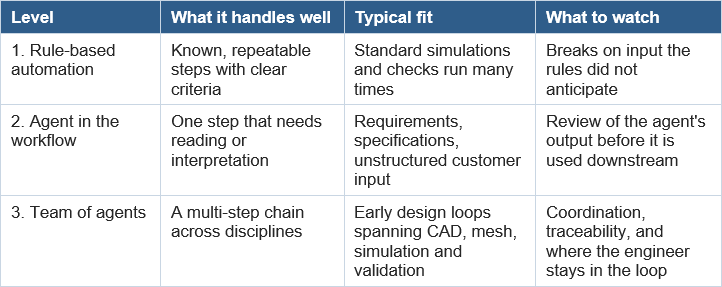
A simple rule of thumb: start from the lowest level that solves the problem. If a task can be written as rules, rules are cheaper to run and easier to trust. Add an agent where a person is currently doing interpretation that does not need their expertise. Consider a team of agents when the bottleneck is the hand-offs between steps, not the steps themselves.
What this means for engineering teams
None of these levels removes the need for simulation expertise. If anything, they make it more visible. Someone has to define the rules at level 1, decide what the agent may and may not do at level 2, and judge whether the combined result at level 3 is physically sound.
What changes is where engineers spend their time. Less of it goes into preparing inputs and moving data between tools, and more of it goes into setting up the process and reviewing the results. That shift is the real story behind Agentic AI in our field.
See the three levels in practice

If you want to see how these levels look on real parts, Synera is hosting the webinar Behind the Scenes of Injection Molding: 3 Use Cases, From Automated Workflow to Team of Agents on Thursday 19 November, with Andrew Sartorelli (Head of Partnerships, Synera), Franz Mook (Senior Solution Advisor Agentic AI, Synera) and Juri Müller (Plastic Engineer, IB-JM). For each use case, they show the outcome, what the engineer stops doing, and what they review instead.
• EU session: 14:00 CET
• US session: 2 PM ET / 11 AM PT