


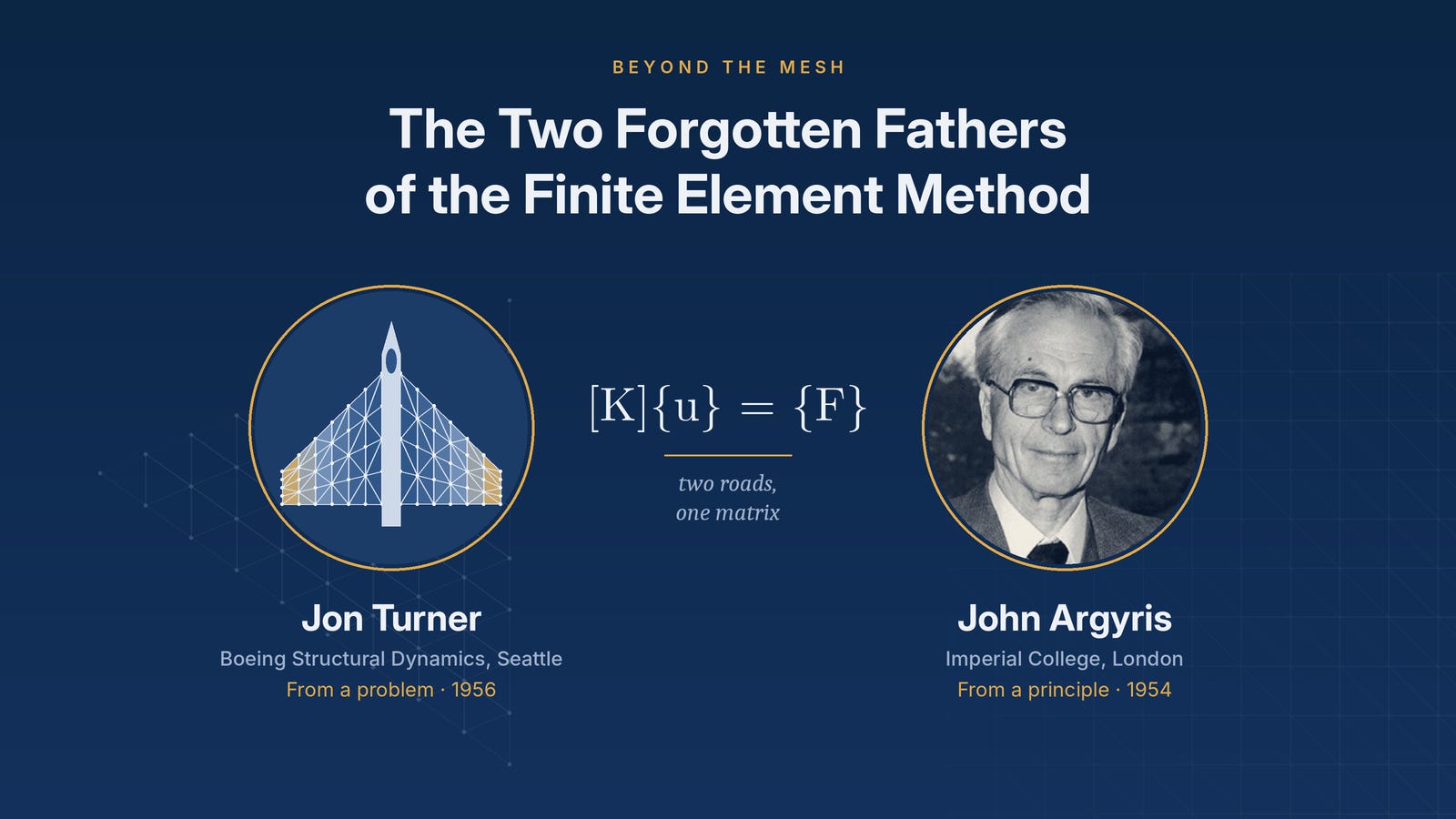
The wing before the name
A month ago I wrote about Ray Clough’s failed summer of 1952 at Boeing. He spent three months trying to model a delta wing with beams, went home without a solution, came back the next year, and eight years later gave the world the phrase “finite element method.” Many of you told me that first summer was the part that stayed with you.
But that story leaves two people in the shadows.
The first is the man who invited Clough to Seattle and, the following summer, suggested the idea that unlocked the problem: Jon Turner. Without Turner there is no Boeing summer program for Clough, no delta wing, and no 1956 paper.
The second never set foot in that Boeing office. In London, a Greek engineer who had escaped Nazi Germany was building his own road to the same destination, starting from energy principles rather than from a specific wing. His name was John Argyris.
Every solver you run today rests on what these two men did in the 1950s. Most analysts I meet cannot name either of them. This article is an attempt to change that, and to ask what their stories say about our work now.
Seattle: Jon Turner and the wing that would not behave
M. Jonathan Turner was born in Oakville, Indiana, in 1915, and was fascinated by airplanes from boyhood. By the early 1950s he led the Structural Dynamics Unit at Boeing in Seattle, and he had a problem that classical methods could not solve.
High-performance military aircraft were moving to delta and swept wings. These were thin, low aspect ratio structures that behaved more like plates than beams. Beam theory, which had served straight wings well for decades, could not predict how they would vibrate. Boeing had even built a fairly large delta wing model to measure its vibration properties, and the analysis could not match it.
Turner’s first move was organizational, not mathematical. Through Boeing’s summer faculty program, he brought in Ray Clough from UC Berkeley and Harold Martin from the University of Washington. Clough later recalled spending the summer of 1952 trying to adapt an existing procedure to the delta wing, the problem that eventually led to the finite element method. The beams failed. In 1953, Turner proposed modeling the wing as two-dimensional plate elements connected at their corners.
What Turner did next is the part history usually skips.
He presented it before it was polished. Turner showed the Boeing work at the January 1954 meeting of the Institute of the Aeronautical Sciences in New York. The paper itself, “Stiffness and Deflection Analysis of Complex Structures” by Turner, Clough, Martin and Topp, did not appear until September 1956, in the Journal of the Aeronautical Sciences, Vol. 23, No. 9.
He built it for the computer. The procedure was designed from the start to be programmed: compute each element’s stiffness, add them into a global matrix, solve. That assembly by direct addition is what we now call the direct stiffness method. In 1959, Turner published a further paper presenting it explicitly as an efficient approach for computer implementation.
He sold it inside Boeing. Turner convinced the company to commit resources to the method. The payoff came a decade later: the Boeing 747, introduced in 1969, was the first major commercial aircraft analyzed extensively with finite elements.
In their own history of early FEM research, Clough and Ed Wilson give Turner principal credit for the 1956 work. Turner died in 1995 at the age of 80. His Seattle Times obituary described a quiet, meditative engineer. A former colleague said the computer-aided design of the 777 still rested on the fundamentals Turner developed.
London: John Argyris and the energy theorems
Argyris took a very different road. He was born Johann Hadjiargyris on 19 August 1913 in Volos, Greece, about 300 km north of Athens. He was educated in Athens, studied civil engineering there and in Munich, and graduated with distinction from the Munich Technical University in 1936.
His early professional work was on guyed masts for radio antennas, which were multiplying across Europe in the 1930s. According to Karl-Eugen Kurrer’s history of structural theory, Argyris showed that the wind load perpendicular to the plane usually considered also had to be checked. Remember that detail. It is the instinct of an analyst who asks about the load case nobody else is running.
Then came the war. Argyris was imprisoned in Germany and escaped; accounts say he swam the Rhine during an air raid to reach Switzerland. He completed his doctorate in aeronautics at ETH Zurich in 1942, and in 1943 moved to England as a technical officer in the Engineering Department of the Royal Aeronautical Society. Part of that work was done as a member of a secret commission, which is one reason so little of it was visible at the time.
Kurrer states that as early as August 1943, Argyris had developed triangular elements for the analysis of swept-back wings. That claim deserves caution, since the wartime work was not published openly. But it places him on the same problem as Turner, a decade earlier and an ocean away.
In 1949 Argyris joined Imperial College London as a senior lecturer, becoming a full professor in 1955. Between 1954 and 1955 he published a long series titled “Energy Theorems and Structural Analysis” in the journal Aircraft Engineering, drawn from his Imperial College lectures. The first installments appeared in late 1954 and already extended the energy principles to temperature effects and nonlinear stress-strain relations. The series was later republished as a book with Sydney Kelsey in 1960.
What the series did was systematize how the elemental components of a structure are assembled into a single system of equations, grounding it all in energy principles and matrix algebra. Force methods and displacement methods appeared as two expressions of one framework rather than rival techniques.
In 1959 Argyris took a joint appointment at Stuttgart, where he directed an institute for aerospace structures and built a campus around digital computing. The ASKA program developed under his direction became the model for many later industrial codes. In 1970 he founded the journal Computer Methods in Applied Mechanics and Engineering, still one of the field’s leading publications. He was elected a Fellow of the Royal Society in 1986 and died in Stuttgart on 2 April 2004, aged 90.
Two roads to the same matrix
Turner came to the method from a problem. Argyris came to it from a principle. Both arrived at a structure assembled from elements, expressed as matrices, and solved by computer.
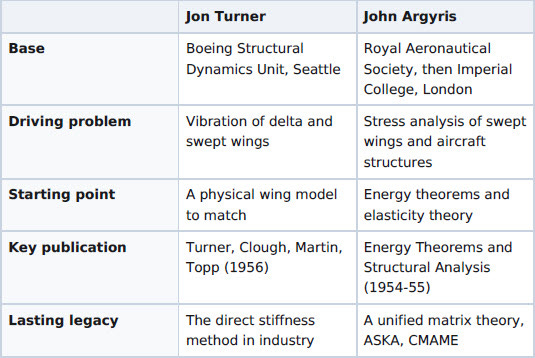
Turner had a specific wing, test data to compare against, and a company that needed answers. He wanted a procedure simple enough that a computer could run it on real aircraft. Argyris wanted a theory general enough to describe any structure as an assembly of parts whose behavior follows from energy.
Neither was complete alone. Carlos Felippa, a former student of Clough, framed this period as a play in three acts. The first act belongs to the 1930s matrix pioneers Collar and Duncan. The second is a period of confusion, when matrix methods grew complicated in response to competing demands. In the third, the direct stiffness method arrived and cleaned it all up, turning matrix structural analysis into the finite element method we use now. Argyris and Turner are the two central figures of that story.
The synthesis is visible in every modern solver. The element formulation owes much to the energy-based thinking Argyris systematized. The assembly, element by element into a global stiffness matrix, is Turner’s direct stiffness method. When you mesh a part and press solve, you are using both.
Why history forgot them
The method has more than two parents, and two of them are well remembered. In 1943, the mathematician Richard Courant solved a torsion problem using simple functions defined over triangular subdomains, a primitive form of the finite element method a decade before Boeing. From the 1960s, Olgierd Zienkiewicz carried the method far beyond aircraft and, in 1967, published the first textbook dedicated to it. Mathematicians cite Courant, and generations of engineers learned FEM from Zienkiewicz.
Turner and Argyris stand between them in time, and receive far less of the credit.
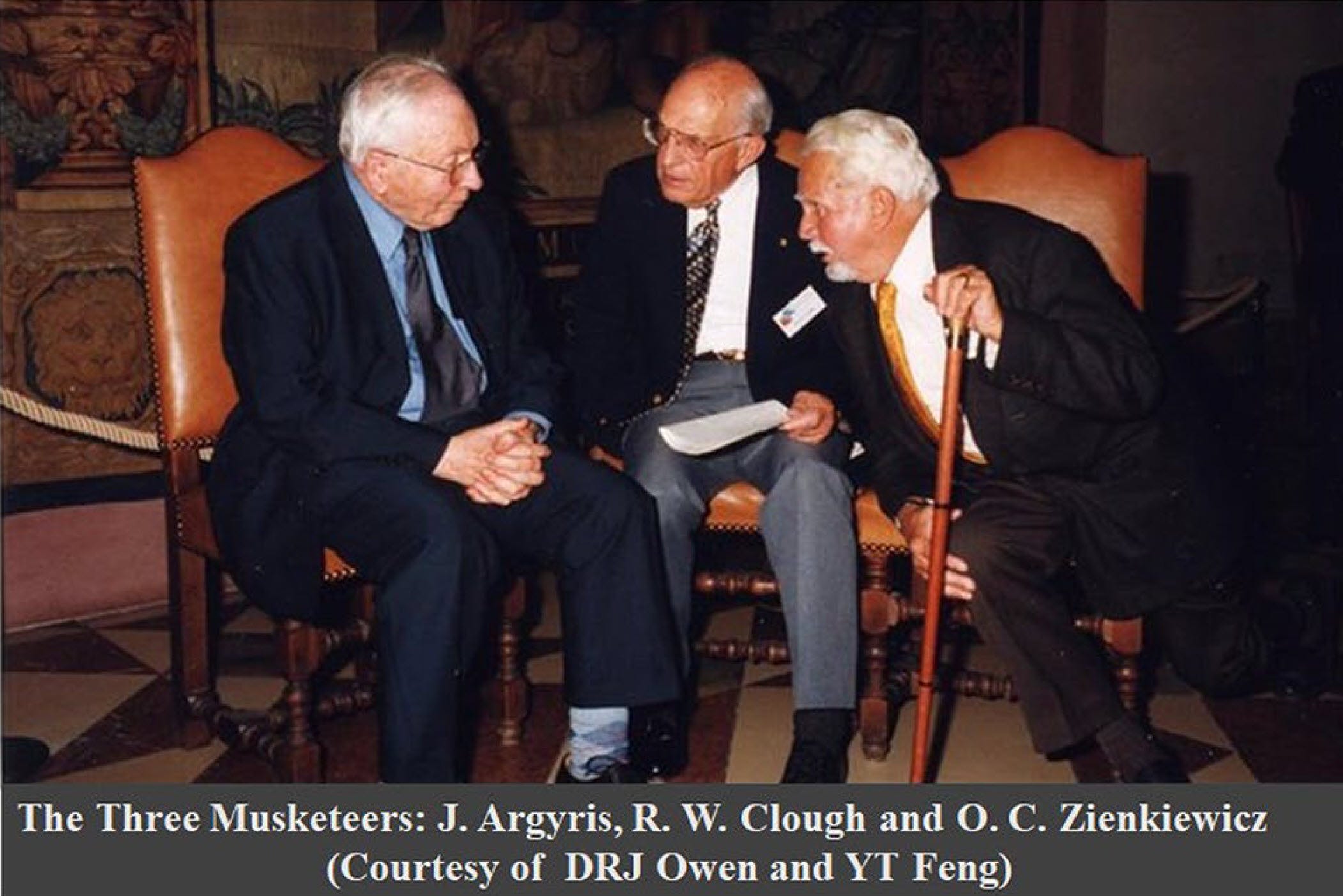
If both men mattered so much, why does the popular story start with Clough? I see three reasons, and none of them is about the quality of the work.
The name wins.
Clough coined “finite element method” in 1960, and a good name travels further than a good paper. Before that, everyone was speaking the language of matrix and direct stiffness methods. Once the field had a name, its history was told around the person who gave it.
Industry does not write textbooks.
Turner spent his career at Boeing. His results lived in internal programs and aircraft designs, and the engineers he trained were Boeing engineers, not graduate students publishing under his name. Academic pioneers build schools that keep their story alive. Industrial pioneers build airplanes.
Secrecy and language.
Part of Argyris’s early work was done under wartime secrecy. His published work was highly mathematical, and his later career centered in Stuttgart. In the English-speaking world, the history of FEM was largely written from the Berkeley side.
There is a lesson here for anyone who builds methods quietly inside a company or a project team. The work can outlive the name unless someone takes the time to write the history down. Clough did that for Turner, in print, decades later.
What Turner and Argyris teach analysts today
History is only useful if it changes how we work on Monday morning. Here is what I take from these two careers.
Start from the structure, not from the tool.
Clough’s beams failed in 1952 because a delta wing does not carry load like a beam. Turner’s plate elements worked because they matched how the structure actually behaves. Before choosing an element type, ask what the structure is really doing. The most sophisticated solver cannot rescue the wrong idealization.
Theory and practice need each other.
Turner without Argyris gives you a procedure that works but may not generalize. Argyris without Turner gives you an elegant framework that may never reach a production aircraft. The best analysts I know carry both: they understand the energy principles behind an element, and they know how it behaves on a real part with real boundary conditions.
Validate against something physical.
Turner’s team had a delta wing model and vibration measurements to compare against. That is what made the method credible inside Boeing. Seventy years later, the principle has not changed. A model that has never been checked against a test, a hand calculation, or a trusted reference is a hypothesis, not a result.
Ask about the load case nobody is running.
Argyris’s early work on radio masts came down to checking a wind direction others assumed did not matter. Every analyst should have that reflex. Many of the failures we study began with a case that was never analyzed.
Name the people behind your tools, and in your own team.
Clough gave Turner principal credit in his own account, and that generosity is part of why we can tell this story at all. In your team, credit the person who suggested the idea that unlocked the problem, even when someone else wrote the report.
The tools have changed beyond recognition since 1956. Turner and Argyris worked on early computers with a tiny fraction of the memory in your phone. But the questions they asked are exactly the ones we still face: What is this structure really doing? Is my model telling me the truth? How do I know?
The next time you assemble a global stiffness matrix with a single click, take a second to remember the quiet engineer in Seattle and the Greek émigré in London who taught us how.
Further reading
Turner, M. J., Clough, R. W., Martin, H. C. and Topp, L. J. (1956). Stiffness and Deflection Analysis of Complex Structures. Journal of the Aeronautical Sciences, 23(9), 805-823.
Clough, R. W. and Wilson, E. L. (1999). Early Finite Element Research at Berkeley.
Argyris, J. H. (1954). Energy Theorems and Structural Analysis. Aircraft Engineering, 26(11), 383-394.
Felippa, C. A. (2001). A historical outline of matrix structural analysis: a play in three acts. Computers & Structures, 79(14), 1313-1324.
National Academy of Engineering (2011). John H. Argyris 1913-2004. Memorial Tributes, Volume 15.
Kurrer, K.-E. Biography of John Argyris, from The History of the Theory of Structures.
Foschini Neto, N. (2020). John Hadji Argyris and the Computational Structural Analysis in British Aircraft Engineering.
The Seattle Times (1995). Jonathan Turner, Airplane Engineer.
Liu, W. K. et al. (2021). Eighty Years of the Finite Element Method: Birth, Evolution, and Future.
Dominique, Argyris checked the masts for wind in the direction nobody else was checking. I keep a list of what every structure has to answer for for the same reason, and lateral stability is on it because I forgot it once. A solver analyses whatever loads you give it, so a load case you never thought to apply isn't in the answer, and nothing on the screen tells you it's missing. Did Argyris write down how he came to check the out-of-plane wind, or does Kurrer only record that he did?